Social Neuron vs Predis.ai: Evidence-Checked Comparison
Published · Updated · 12 min readSocial Neuron vs Predis.ai: which should you choose?
Choose Predis.ai when your main job is producing ads and social creative through a documented template, brand, calendar, approval, and scheduling workflow. Consider Social Neuron when you need project-scoped brand context, approval boundaries, developer access, and an operating loop that can preserve evidence between stages. Current evidence does not show that either product improves audience or business outcomes more than the other.
That last sentence is the important one. The previous version of this comparison invented a month-three and month-six performance gap. It also treated untested competitor capabilities as absent. Those claims are withdrawn.
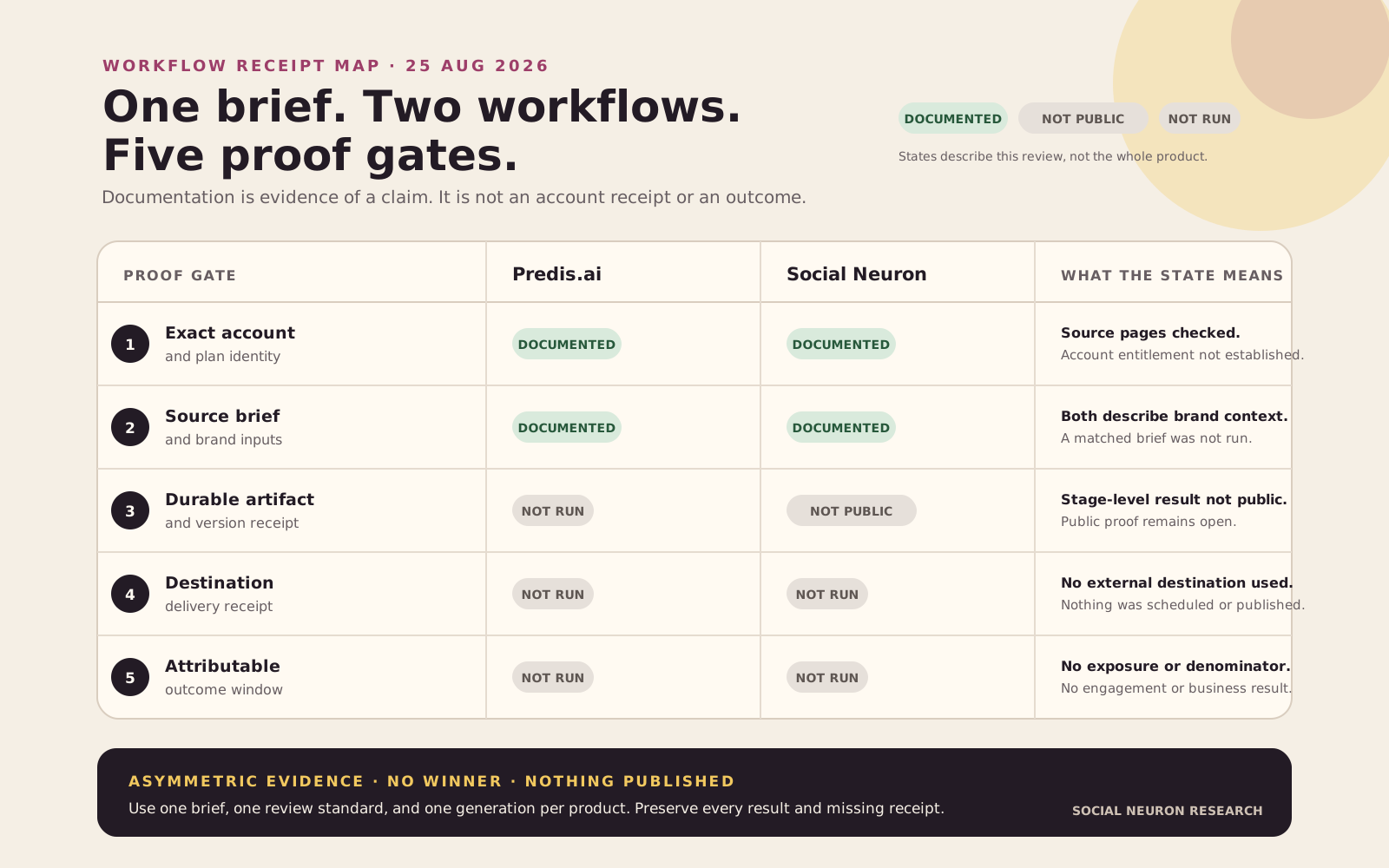
This review uses six public evidence states:
- Documented: a current first-party page describes the capability.
- Verified: an independently inspectable public receipt proves the bounded operation completed.
- Failed: the overall release decision did not meet publication standard; this does not establish a named stage result.
- Not run: this review did not test the capability against an account.
- Not public: a private evaluation exists, but stage-level evidence is withheld and no named stage claim is made.
- Not established: the public evidence available for this review cannot support the claim.
Unknown is not a polite spelling of no. It means the evidence is still open.
What Predis.ai currently documents
Predis.ai is not just a carousel generator. Its current first-party pages describe a wider production surface:
- ad and social creative generation;
- brand settings and workspaces;
- team approvals;
- a content calendar and scheduling;
- analytics and competitor-content analysis;
- current model integrations; and
- Core, Rise, and Enterprise+ plan labels.
The current Predis.ai pricing page is the correct place to inspect plan names and entitlements. This article deliberately omits a starting price because the billing basis, account display, and plan details can change faster than the comparison can be reviewed.
Its competitor-content analysis page describes grouping competitor posts by content theme and comparing engagement scores. That supports a documented analysis surface. It does not prove that the recommendations cause better performance.
Its scheduling page describes calendar, creation, and scheduling work in one product. We did not connect a Predis.ai account, generate an artifact, or verify a destination receipt. Every hands-on Predis.ai cell in this review therefore remains Not run.
What Social Neuron currently documents
Social Neuron's current public surfaces describe project-scoped brand context, content creation, approvals, scheduling, analytics, and a developer surface. The Brand Brain page explains the persistent brand context. The developer surface describes agent and API entry points.
The product's public, pricing, integration, and MCP sources do not currently agree on every plan scope, platform state, or tool count. This article therefore does not publish a plan price, platform total, model list, or MCP tool total. A buyer should inspect the exact account entitlement needed for the job.
Social Neuron also does not get a free pass because we can inspect it more closely. One private evaluation did not meet publication standard or establish a complete public proof receipt. Only that release decision is public; stage-level execution and storage details are intentionally withheld. Nothing was scheduled or published.
The public summary therefore marks the overall release decision Failed while leaving specific workflow stages Not public. It did not test Predis.ai and cannot establish a comparative winner.
The evidence-checked workflow matrix
| Buyer job | Predis.ai | Social Neuron | What to verify in your account |
|---|---|---|---|
| Brand inputs | Documented through brand settings and workspaces | Documented through Brand Brain and project context | Which fields are stored, versioned, and applied to the artifact |
| Creative production | Documented for ads and social formats | Documented across current content surfaces | Exact format, model if exposed, limits, and artifact ID |
| Artifact and version receipt | Not run | Not public | Public proof state, source brief, version, approval state, and exact actions not taken |
| Approval | Documented on current product and plan pages | Documented in current workflow surfaces | Who can approve, what version is approved, and whether edits invalidate approval |
| Calendar and scheduling | Documented | Documented | Exact connected account, scheduled state, and destination receipt |
| Analytics | Documented | Documented | Measurement status, denominator, window, account identity, and missing-data behavior |
| Competitor-content analysis | Documented for themes and engagement-score comparison | Not established in this review | Source coverage, platform scope, and whether output is descriptive or prescriptive |
| Developer or agent surface | Not established in this review | Documented | Current authentication, account scope, permission boundary, and returned IDs |
| Audience or business outcome | Not established | Not established | Artifact exposure, attribution, signup, activation, payment, and retention receipts |
Sources were retrieved on 24 August 2026. The table compares evidence states, not marketing adjectives.
What each product is better positioned for
Predis.ai is the clearer documented fit when
- the job begins with ad or social creative production;
- a template-led workflow is useful rather than restrictive;
- brand settings, collaboration, and approvals need to sit near creation;
- competitor-content themes are part of the research process; or
- the team wants creation, calendar, and scheduling described in one vendor workflow.
This is a fit assessment from current first-party documentation. It is not a hands-on product review.
Social Neuron is the clearer documented fit when
- the workflow starts from a named project and persistent brand context;
- an agent or developer surface is part of the operating model;
- explicit approvals and receipt checks need to sit between generation and distribution;
- the team wants to connect creation, delivery, analytics, and the next decision; or
- a verifier must be able to stop the workflow when identity or evidence is incomplete.
The social-agent operating loop explains this control model. The independent verifier guide explains why the system making a claim should not be the only system checking it.
Social Neuron's broader operating model is not proof that every path is reliable or that the loop improves performance. The private evaluation did not meet publication standard. The product still needs exact-account delivery and outcome evidence.
Why the old winner story was removed
The previous article claimed that Predis.ai users plateau while Social Neuron improves after three months and pulls away after six. No matched cohort, common brief, artifact lineage, exposure record, or attributable outcome supported that forecast.
It also claimed:
- exact workflow times that were never measured;
- fixed prices without a billing-basis check;
- absent analytics and feedback capabilities without an exhaustive test;
- a specific Social Neuron model list that no longer matched the exposed configuration;
- automatic insights with invented engagement percentages; and
- savings against a part-time strategist without matching scope or outcomes.
Removing those lines makes the comparison less dramatic and more useful. A buyer can now see what is documented, what failed, and where a trial is still doing real work.
How to run a fair one-brief comparison
Use the product-neutral workflow receipt sheet. Freeze the test before opening either product.
1. Register one job
Choose one non-sensitive brief, target format, brand input set, review criteria, and time budget. The brief must be identical for both products. Do not add extra context after seeing the first result.
2. Record account identity
Capture the exact product, plan, workspace, project, and permissions. A plan-page feature is not an account entitlement until the account exposes it.
3. Allow one generation
Create one internal draft in each product. Do not regenerate the weaker result. Preserve both outputs, including a failure.
4. Bind the review to an artifact
Record the durable artifact or version identifier, source brief, brand inputs, platform lineage, and reviewer decision. If the product cannot return or preserve the ID, mark the public proof incomplete.
5. Stop before publishing
The workflow test does not need an external post. A separate approval must name an exact artifact, destination account, allowed action, and required destination receipt.
The cross-platform proof protocol shows how identity, approval, delivery, and measurement receipts connect. The MCP connector comparison applies the same rule to agent tools.
6. Measure only after verified exposure
If a later publication experiment is approved, change one editorial variable. Record the exact external post, exposure status, denominator, and article-attributed demand plus server-side signup and activation at 1 hour, 24 hours, 7 days, 14 days, and 28 days. Missing analytics stays unavailable, not zero.
Limitations and falsifier
This is an asymmetric review. Predis.ai was checked through current first-party pages and was not run against an account. Social Neuron had one private evaluation, and only its release decision is public. Neither product was tested for audience response, signup, activation, payment, retention, or causal lift.
First-party documentation can omit limits or describe a capability more broadly than an account exposes it. An independent hands-on reviewer is still required before publication approval.
Withdraw or update a matrix row when its cited page no longer supports the claim, an account does not expose the documented entitlement, or a controlled run contradicts the state. Withdraw any outcome statement without exact artifact exposure, a denominator, an attribution method, and a registered measurement window.
Frequently asked questions
What is the main difference between Predis.ai and Social Neuron?
Predis.ai currently documents an ad-and-social creative workflow with brand settings, collaboration, analysis, calendar, and scheduling surfaces. Social Neuron documents a project-scoped content operations workflow with brand context, approvals, analytics, and developer entry points. Account testing is required before treating either documented surface as execution proof.
Which product supports social scheduling?
Both products document scheduling surfaces. This review did not verify a Predis.ai schedule or a Social Neuron external destination receipt. Check the exact connected account, platform path, plan entitlement, and returned receipt before choosing.
Does either product prove that AI content improves engagement?
No. Current evidence does not establish a causal engagement, conversion, revenue, or retention advantage for either product. A generated artifact and a successful schedule are workflow evidence, not audience or business outcomes.
How should a team compare the products fairly?
Use the same brief, brand inputs, format, time budget, one-generation rule, blind review criteria, and receipt requirements. Preserve both failures. Keep publishing outside the workflow test unless a separate approval names the artifact and destination.
Are the listed prices and plan entitlements current?
This article omits price figures. Predis.ai's official pricing page and Social Neuron's current account surface should be checked on the decision date. Record the billing basis and exact entitlement rather than copying an old monthly number.
Sources
Retrieved 24 August 2026:
- Predis.ai, homepage.
- Predis.ai, pricing and plan entitlements.
- Predis.ai, social media scheduling tool.
- Predis.ai, competitor content analysis.
- Social Neuron, Brand Brain and developer surface.
Next step: Download the workflow receipt sheet, test one internal draft per product, and leave every missing receipt open.