Social Media MCP Connectors for AI Agents: Evidence-Checked Guide
Published · Updated · 11 min readWhich social media tools have MCP support?
As of 24 August 2026, current first-party pages verify MCP surfaces for Social Neuron, Postiz, Post Bridge, Typefully, and Hootsuite. These are verified examples, not an exhaustive market census. An MCP page proves that a vendor documents a connector. It does not prove that authentication, project selection, drafting, publishing, or analytics work for your account.
The best social media MCP connector is therefore not the one with the longest feature table. It is the one that can complete your exact job with the smallest permission set and return evidence you can inspect.
This comparison uses six public evidence states:
- Documented: a current first-party page describes the MCP surface.
- Verified: an independently inspectable public receipt proves the bounded operation completed.
- Failed: the overall release decision did not meet publication standard; this does not establish a named stage result.
- Not run: this review did not test the operation against an account.
- Not public: a private evaluation exists, but stage-level evidence is withheld and no named stage claim is made.
- Not established: the public evidence available for this review cannot support the claim.
If a cell does not have the evidence for one of those states, it stays unknown. Unknown is not the same as no.
The evidence-checked connector comparison
| Connector | Current first-party evidence | What that evidence supports | Public review state | What remains unproven here |
|---|---|---|---|---|
| Social Neuron | Developer surface plus a publisher disclosure in this article | The documentation describes hosted MCP access, project selection, brand-context reads, and bounded content generation; the disclosure supports only the overall release decision | Failed overall: the private evaluation did not meet publication standard; named stages are Not public, and nothing was published | An independent run receipt, reviewable saved-platform draft, destination publish receipt, audience response, and business outcome |
| Postiz | MCP introduction and tool reference | Its docs describe integrations, draft/schedule/immediate-publish operations, post listings and settings, and media tools | Not run | Account-specific authentication, platform delivery, failure handling, and external receipts |
| Post Bridge | MCP setup and tool guide | Its guide describes OAuth or API-key setup plus content, scheduling, media, and analytics operations | Not run | Account-specific permissions, destination state, retry behavior, and outcome lineage |
| Typefully | AI agents page | Its page describes MCP and Agent Skill paths for drafting, refinement, scheduling, publishing, feedback, and calendar work | Not run | Account-specific scope, external receipts, analytics lineage, and failure behavior |
| Hootsuite | MCP integration page | A current official MCP integration surface exists | Not run | The usable tool boundary, account eligibility, write behavior, receipts, and outcomes |
Sources were retrieved 24 August 2026. The Social Neuron evaluation is a publisher disclosure, not an independently inspectable run receipt. Vendor pages can change. Recheck the exact source and your account entitlement before granting write access.
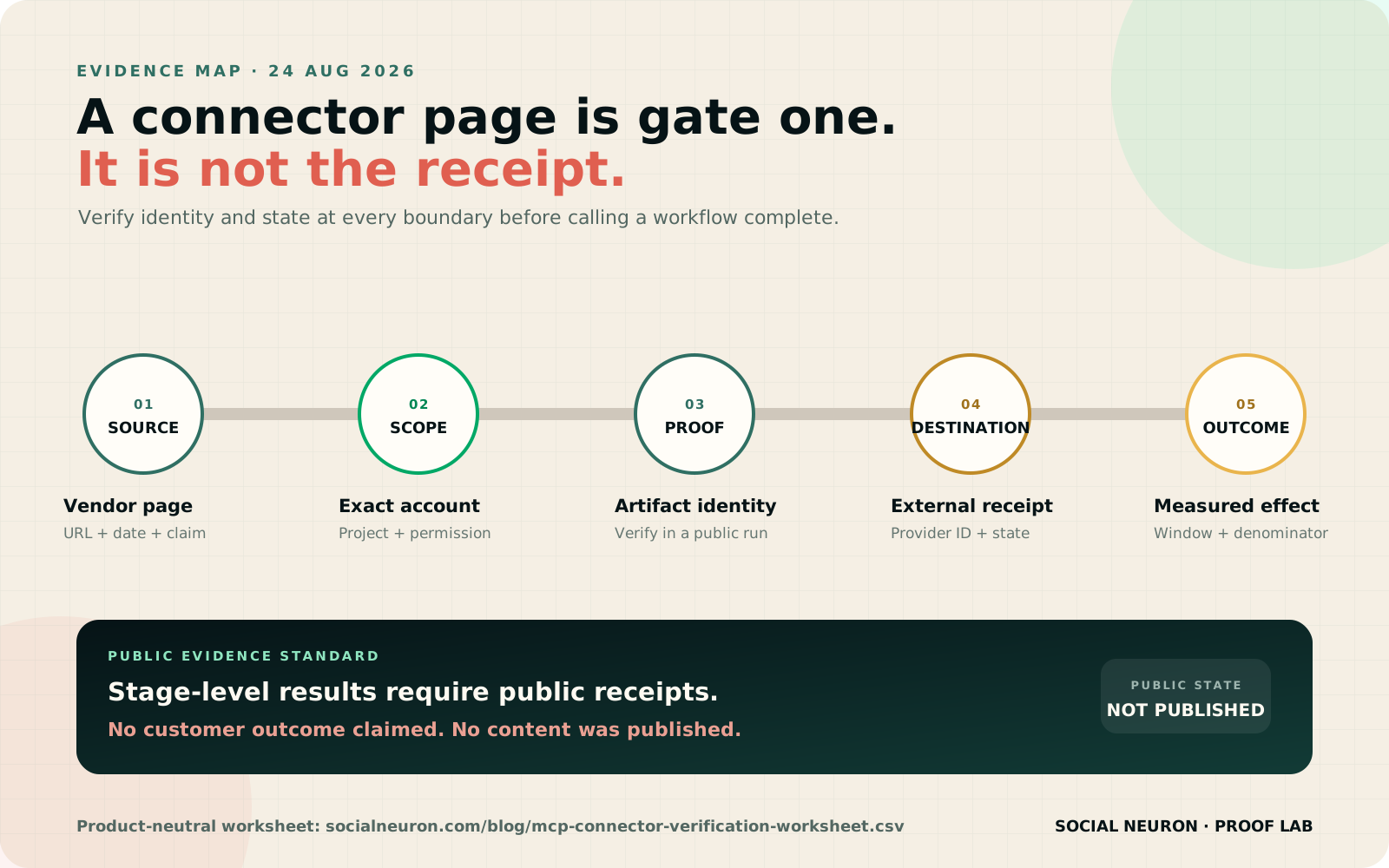
Compare the workflow, not the marketing nouns
MCP standardizes how a client and server exchange tools and context. It does not standardize product quality, account permissions, or proof that an external network accepted a post. A useful comparison follows the workflow from left to right.
1. Source receipt
Record the exact first-party page, retrieval date, and claim. A vendor homepage is not enough for a detailed capability, price, or platform claim. Link the setup or tool page that contains it.
2. Client and transport
Identify the client and connection type you will actually use. A connector can be documented and still fail because the client does not support the required transport, authentication flow, or tool approval model.
For protocol background, read what MCP means for content creators. For a repository-centered implementation, see the AI content pipeline with MCP.
3. Account and project identity
Name the exact brand, workspace, and destination account before any write. Multi-project ambiguity should stop the run. A successful response attached to the wrong project is not a success.
4. Permission boundary
Separate read, internal draft, schedule, publish, reply, and account-management permissions. Tool availability is not task approval. Start read-only, then allow one internal draft. Add an external action only through a new, specific approval.
5. Durable artifact identity
A reviewable draft needs an identifier or version you can bind to an approval. Generated text in a chat window is not enough. Store the source brief, project, platform, checks, and artifact identity together.
6. Destination receipt
An MCP tool saying done is not proof that a social network accepted the post. Require the destination identifier and, where practical, query external state before recording CONFIRMED. If the result is uncertain, use UNKNOWN and inspect before retrying.
7. Outcome lineage
Delivery is not performance. A case study needs the exact artifact, verified exposure, measurement window, denominator, attributable demand, and activation definition. Missing analytics is unavailable, not zero.
Use the product-neutral MCP connector verification worksheet to record these receipts before choosing a connector.
What the public Social Neuron evaluation summary establishes
We evaluated Social Neuron because it is the product we can inspect most closely. Only the release decision is public; stage-level execution and storage details are not.
The overall release decision was Failed.
- The evaluation did not meet publication standard.
- Stage-level results are not public evidence.
- Nothing was published.
Exact internal evaluation and storage details are intentionally withheld.
This is not a customer result, a publishing case study, or proof of audience performance. It is an editorial release decision, not evidence that any particular workflow stage succeeded or failed.
That distinction matters. A vendor comparison should not promote a documented capability to a completed workflow when its artifact identity or public receipt is missing.
What the other official pages establish
Postiz
Postiz publishes a dedicated MCP introduction, client setup, examples, and a tool reference. The current introduction describes operations for listing integrations, drafting or scheduling posts, publishing immediately, reading post state, changing draft settings, and generating media. It also documents API-key and bearer-token connection paths.
We did not connect a Postiz account or run a post workflow. This page therefore marks the surface Documented and the execution Not run.
Post Bridge
Post Bridge publishes an MCP setup guide with OAuth and API-key paths. Its current guide covers content creation, scheduling, updates, deletion, media, and analytics retrieval. That makes it relevant when an agent needs a posting-oriented control surface.
We did not test account scope, platform delivery, or a destination receipt. Those states remain unknown here.
Typefully
Typefully's current AI-agents page describes both chat-based MCP access and an Agent Skill path. It documents drafting, refinement, feedback, calendar management, scheduling, and publishing.
We did not test those operations against an account. The page supports a documented-capability claim, not a delivery or outcome claim.
Hootsuite
Hootsuite publishes a current MCP integration page. This review verified that first-party surface but did not test its account eligibility, tool scope, or execution behavior. It remains in the comparison as a documented connector with a deliberately incomplete evidence row.
How to choose a social media MCP connector
Choose from your required job and evidence standard:
- Repository and project-scoped content work: verify explicit project selection, artifact identity, and approval boundaries before a write. The Claude Code workflow guide shows the control model; Social Neuron's publisher-disclosed overall release decision remains below publication standard.
- Drafting and writing workflows: Typefully documents a focused agent surface. Test your required feedback, calendar, and destination path before selection.
- Posting and cross-platform operations: Postiz and Post Bridge document posting-oriented MCP tools. Verify the exact destination account and receipt behavior rather than relying on a platform total.
- Existing enterprise social operations: Hootsuite has an official MCP integration surface. Confirm entitlement and usable tool scope inside your own account.
- Multi-stage autonomous workflows: use the social-agent operating loop and require an independent verifier. More tools do not remove the need for approvals and receipts.
There is no universal winner in this evidence set. The decision changes with the job, client, account, required permission, and receipt standard.
Claims deliberately excluded
This refresh removes vendor price snapshots, exact tool totals, broad platform totals, model-family counts, unsupported exclusivity, and claims that analytics automatically become learning. Those claims expire quickly and were not needed to answer the reader's decision.
It also avoids ranking a connector from a homepage, a generated summary, or a community post. Community discussion can reveal demand. It does not verify a vendor capability.
A safe connector evaluation prompt
Use this before any external write:
Use only read tools for project [exact name]. Return the project identifier, current brand context, available analytics window, sources, and unavailable fields. Do not create, schedule, publish, reply, or alter an account. Stop if the project is ambiguous.
Then test one internal artifact:
Create one platform-targeted draft from approved brief [identifier]. Return the durable artifact identifier, project, platform lineage, checks, unresolved claims, and exact actions not taken. Do not schedule, publish, reply, or contact an external account. Reject the run if the identifier or platform lineage is missing.
Only after that path returns the required receipts should a separate approval name an exact artifact version, destination account, allowed action, and required destination receipt.
The verifier guide explains why the check should be independent of the system that produced the claim.
Limitations and falsifier
Only Social Neuron has a private publisher evaluation in this review, and only its overall release decision is public. That decision did not meet publication standard or establish complete public proof. The other rows use dated first-party documentation and are not hands-on reviews. No connector was tested for audience response, signup, activation, revenue, retention, or causal lift. Pricing is intentionally excluded.
Withdraw a vendor row if its cited first-party MCP page disappears or no longer supports the stated operation. Withdraw any recommendation if an account-scoped test cannot preserve project identity, permission state, artifact identity, or destination evidence.
Frequently asked questions
What is a social media MCP connector?
It is an MCP server that exposes social-media-related tools or context to an MCP client. The exact scope varies by vendor. Inspect the current tool schemas and permissions rather than assuming every connector can create, publish, and measure.
What is the best social media MCP server?
There is no universal winner. Choose the connector that completes your required workflow with the smallest permissions and returns durable internal and external receipts. Documentation is the first check, not the final proof.
Does a successful MCP call mean a post is live?
No. The call may have created internal state, submitted an external request, or returned before destination confirmation. Require a destination identifier and verify external state before recording CONFIRMED.
Did the Social Neuron test prove publishing works?
No. The private evaluation did not provide public publishing proof, and nothing was published. Stage-level results are not public.
Sources
Retrieved 24 August 2026:
- Model Context Protocol, Architecture overview.
- Postiz, MCP introduction and tools reference.
- Post Bridge, MCP setup guide.
- Typefully, Give AI Agents Social Media Skills.
- Hootsuite, MCP integration.
- Social Neuron, developer surface.
Next step: Download the worksheet, test one read-only path, and inspect the receipt before comparing plans or granting write access.