Social Neuron vs Postiz: Evidence-Checked Comparison
Published · Updated · 12 min readSocial Neuron vs Postiz: which should you choose?
Choose Postiz when open-source self-hosting, a hosted scheduling product, or its documented API, CLI, webhook, and MCP paths fit your operating model. Consider Social Neuron when you want a hosted, project-scoped content workflow with persistent brand context, approval boundaries, analytics, and agent entry points. Current evidence does not prove that either product improves engagement or business outcomes more than the other.
The old article called this a scheduler-versus-intelligence contest. That was a false binary. Postiz currently documents creation, analytics, developer, and agent surfaces as well as scheduling. Social Neuron documents a wider operating loop, but documentation does not prove reliability or performance.
This review uses six public evidence states:
- Documented: a current first-party page describes the capability.
- Verified: an independently inspectable public receipt proves the bounded operation completed.
- Failed: the overall release decision did not meet publication standard; this does not establish a named stage result.
- Not run: this review did not test the capability against an account or deployment.
- Not public: a private evaluation exists, but stage-level evidence is withheld and no named stage claim is made.
- Not established: the public evidence available for this review cannot support the claim.
An unknown cell stays open. It does not become no because a comparison table wants symmetry.
First choose Postiz Cloud or self-hosting
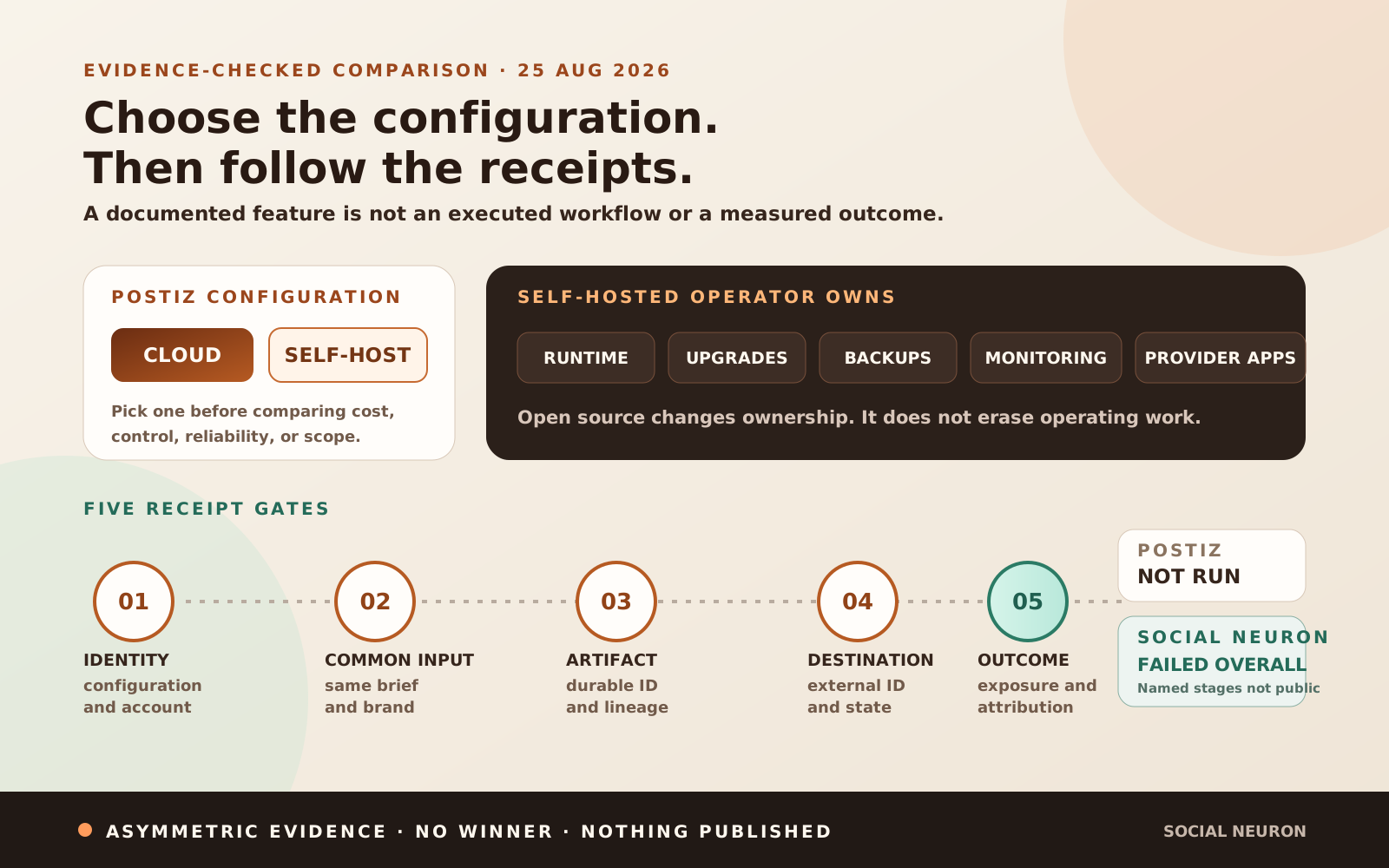
Postiz documents both a hosted cloud product and an open-source self-hosted path. Those are different configurations with different owners, costs, and evidence.
Postiz Cloud
The current Postiz pricing page documents hosted plans with channel, creation, analytics, team, API, and webhook entitlements. A buyer should check the exact plan and account surface on the decision date. This article omits prices and allowance totals because they are volatile and were not needed to compare the operating model.
Self-hosted Postiz
The Postiz installation documentation and source repository document a self-hosted route. That gives an operator more control over deployment and code inspection. It also transfers work.
The operator owns infrastructure, upgrades, backups, monitoring, incident response, and the provider applications or credentials required by connected networks. Open source does not mean zero operating cost. Self-hosting also does not prove a specific data-residency or compliance outcome without inspecting the chosen infrastructure and every external provider path.
Do not compare Postiz Cloud pricing with self-hosted control in one row. Choose one configuration before any hands-on test.
What Postiz currently documents
Postiz's current documentation introduction describes scheduling and publishing, per-platform tailoring, AI-assisted content generation, cloud deployment, self-hosting, a public API, a CLI, and MCP access. Its public product surfaces also describe analytics, teams, and automation.
The current Postiz MCP reference documents account listing, platform schemas and validation, draft creation, scheduling, immediate publishing, post state, settings, and image and video operations. That directly contradicts the previous article's claim that Postiz had no MCP server.
We did not connect a Postiz account, deploy its repository, generate an artifact, or verify an external destination. The capabilities above are Documented only.
What Social Neuron currently documents
Social Neuron's public surfaces describe project-scoped brand context, creation, approvals, scheduling, analytics, and a developer surface. The Brand Brain page explains persistent brand context. The developer surface describes agent and API entry points.
Current public, pricing, integration, and MCP sources do not agree on every plan scope, platform state, model, or tool count. This comparison omits those totals instead of selecting the most flattering surface.
One private Social Neuron evaluation did not meet publication standard or establish a complete public proof receipt. Only that release decision is public; stage-level execution and storage details are intentionally withheld. Nothing was scheduled or published.
The overall release decision is Failed. Named workflow stages are Not public, so this page makes no claim that a particular stage succeeded or failed. Current evidence does not establish a winner.
The evidence-checked workflow matrix
| Buyer decision | Postiz | Social Neuron | What must be verified |
|---|---|---|---|
| Deployment ownership | Cloud and self-hosted paths documented | Hosted product documented | Exact configuration, runtime owner, upgrade owner, backups, and provider-app boundary |
| Brand and creative inputs | Creation and account surfaces documented | Brand Brain and project context documented | Which inputs are versioned and applied to the artifact |
| Scheduling and publishing | Documented in product, API, and MCP surfaces | Documented in current workflow surfaces | Connected-account identity, approval state, destination ID, and final external state |
| Platform validation | MCP schemas and validation errors documented | Platform checks documented | Constraint coverage, failure behavior, and whether review binds to an artifact version |
| Analytics | Documented | Documented | Measurement status, denominator, window, account identity, and missing-data behavior |
| Developer and agent surface | API, webhooks, CLI, and MCP documented | Developer and MCP surfaces documented | Current authentication, permissions, account scope, tool schema, and returned IDs |
| Durable artifact receipt | Not run | Not public | Artifact ID, source brief, platform lineage, release state, approval, and exact actions not taken |
| Closed learning or audience outcome | Not established | Not established | Verified exposure, decision lineage, denominator, attribution, signup, activation, and retention |
Sources were retrieved on 24 August 2026 and all cited Postiz pages returned HTTP 200 on 25 August 2026. The matrix compares evidence states, not product slogans.
Where Postiz is the clearer documented fit
Postiz is the clearer fit from current documentation when:
- self-hosting or source inspection is an explicit requirement;
- the team already owns the infrastructure and operational work;
- a hosted scheduling and cross-posting workflow is the primary job;
- API, webhook, CLI, or MCP integration belongs near distribution; or
- the team wants creation, calendar, publishing, and analytics described inside one product.
This is not a reliability claim. A documented schedule operation still needs an account-scoped run and destination receipt.
Where Social Neuron is the clearer documented fit
Social Neuron is the clearer fit from current documentation when:
- a hosted service is preferred over owning deployment operations;
- the workflow begins with a named project and persistent brand context;
- explicit review, approval, and evidence checks sit between creation and distribution;
- the team wants an agent to work across creation, delivery, analytics, and the next decision; or
- an independent verifier should stop the workflow when identity or evidence is incomplete.
The social-agent operating loop explains the control model. The independent verifier guide explains why a system should not grade its own external-state claim.
Social Neuron still needs exact-account delivery and outcome proof. Stage-level results are not public.
Why the old winner story was removed
The previous comparison claimed that one team would publish hundreds of posts and remain flat while a Social Neuron team would improve because its system learned. No matched cohort, common brief, artifact lineage, verified exposure, denominator, or attribution supported that story.
It also published:
- a stale repository-star count as a quality signal;
- conflicting platform totals;
- prices without a current billing-basis check;
- unsupported database and rate-limit claims;
- a universal scheduling-reliability claim;
- false no-MCP and no-analytics cells;
- an unverified Social Neuron model, plan, client, and tool matrix;
- an unsupported brand-safety claim; and
- an arbitrary audience-size range for the recommended buyer.
Every one of those claims is removed. The new comparison makes a deployment decision first, then follows one workflow through inspectable receipts.
How to run a fair configuration-locked test
Use the product-neutral deployment receipt sheet. The test stops before any external write.
1. Lock the configuration
Choose Postiz Cloud or one named self-hosted deployment. If self-hosted, record the repository version, infrastructure owner, upgrade plan, provider applications, and connected-account boundary. Do not borrow cloud entitlements for a self-hosted run.
2. Freeze one brief
Use the same non-sensitive source brief, brand inputs, target format, platform, review criteria, time budget, and one-generation rule for both products.
3. Record exact identity and permissions
Capture product, plan or deployment version, workspace, project, connected account, and allowed actions. Stop when any identity is ambiguous.
4. Produce one internal draft
Do not regenerate the weaker result. Preserve the artifact, including a failure. Record its durable identifier, source brief, platform lineage, reviewer decision, and exact actions not taken.
5. Stop before publishing
The content test does not require distribution. A separate approval must name an exact artifact version, destination account, allowed action, and required external receipt.
The cross-platform automation proof protocol shows the identity-to-outcome chain. The MCP connector comparison applies the same receipt rule to agent tools.
6. Measure only after verified exposure
If a later editorial experiment is approved, change one answer-block variable. Record the exact external artifact, exposure status, denominator, and article-attributed demand plus server-side signup and activation at 1 hour, 24 hours, 7 days, 14 days, and 28 days. Missing analytics remains unavailable, not zero.
Limitations and falsifier
This is an asymmetric documentation review. Postiz was not run in Cloud or self-hosted form. Social Neuron had one private evaluation, and only its release decision is public. Neither product was tested for destination reliability, audience response, signup, activation, payment, retention, or causal lift.
Self-hosting changes operational control but does not remove dependencies on social networks, model providers, infrastructure, or account permissions. First-party documentation can also describe a capability more broadly than a plan or deployment exposes.
Withdraw or update a matrix row when its cited source no longer supports the claim, an account or deployment does not expose the documented operation, or a controlled test contradicts the state. Withdraw any outcome statement without exact artifact exposure, a denominator, an attribution method, and a registered measurement window.
Frequently asked questions
Is Postiz open source and self-hostable?
Yes. Postiz publishes a source repository and self-hosted installation documentation. The operator still owns infrastructure, upgrades, monitoring, backups, provider applications, and connected-account security. Open source is a deployment option, not a zero-cost or automatic-compliance result.
Does Postiz have an MCP server?
Yes. Postiz publishes an MCP introduction and tool reference covering account, schema, draft, schedule, publish, post-state, settings, image, and video operations. This review did not test those tools against an account.
Which product documents AI content creation and scheduling?
Both do. The meaningful comparison is the exact format, account entitlement, approval boundary, artifact identity, destination receipt, and failure behavior required for your job.
Does either product prove a closed learning loop?
Not in this review. Analytics availability is not proof that an outcome changes a later decision. A closed-loop claim requires the decision, action, outcome, policy update, and later policy read on one attributable trace.
How should a team compare hosted and self-hosted social tools fairly?
Lock one configuration, record who owns each operational dependency, and run the same brief under the same constraints. Do not compare a hosted plan's convenience with a self-hosted deployment's control as though they were the same variable.
Sources
Retrieved 24 August 2026 and reachability checked 25 August 2026:
- Postiz, homepage and pricing.
- Postiz, documentation introduction.
- Postiz, self-hosted Docker Compose installation.
- Postiz, MCP tool reference.
- Postiz, source repository.
- Social Neuron, Brand Brain and developer surface.
Next step: Choose one Postiz configuration, download the receipt sheet, and leave every untested execution or outcome cell open.