Social Neuron vs GenViral: Evidence-Checked Comparison
Published · Updated · 13 min readSocial Neuron vs GenViral: which should you choose?
Choose GenViral when its documented agent, MCP, REST, CLI, creation, scheduling, publishing, and analytics surfaces match your exact account and task. Consider Social Neuron when a project-scoped content workflow, persistent brand context, explicit checks, and approval boundaries matter. Current evidence does not prove that either product produces better audience or business outcomes.
The old comparison said GenViral had no MCP server and required a custom wrapper. That is now false. GenViral publishes an OAuth-scoped MCP endpoint and a machine-readable server card. The useful question is no longer which vendor can say MCP. It is which permissions, artifact receipts, destination states, and measurements the exact workflow can prove.
This review uses six public evidence states:
- Documented: a current first-party page or machine-readable card describes the capability.
- Verified: an independently inspectable public receipt proves the bounded operation completed.
- Failed: the overall release decision did not meet publication standard; this does not establish a named stage result.
- Not run: this review did not test the operation against an account.
- Not public: a private evaluation exists, but stage-level evidence is withheld and no named stage claim is made.
- Not established: the public evidence available for this review cannot support the claim.
Unknown stays unknown. A missing run is not a missing feature.
What GenViral currently documents
GenViral's current agent page documents MCP and REST access for agent-driven content work. Its machine-readable MCP server card describes OAuth authorization with read, write, publish, and generate permission groups. Those groups matter because reading a library, generating an asset, creating a draft, and publishing to an external account are different authorities.
The current Partner API documentation describes account-scoped authentication, post lifecycle operations, platform capability lookup, analytics, slideshows, Studio AI, and agent-runtime guidance. The GenViral product surface also describes creation, scheduling, publishing, analytics, automation, API, CLI, skill, and hosted-account paths.
Its current pricing surface names Creator, Professional, Business, and Scale plans with different credits, account limits, automation allowances, and developer access. This article omits dollar amounts and entitlement totals because they are volatile and were not needed to compare the workflow. A buyer should verify the exact plan and billing basis on the decision date.
We did not create a GenViral account, start a trial, connect its MCP endpoint, inspect an account-specific schema, generate an asset, create a draft, or verify a destination. Every GenViral capability in this review is Documented only.
Vendor-curated stories can show which jobs the vendor wants to own. They do not establish independent reliability, comparative quality, causal reach, or a Social Neuron result.
What Social Neuron publicly documents and discloses
Social Neuron's developer surface describes hosted agent and API entry points. Its Brand Brain surface describes project-scoped brand context. Public product pages also describe creation, approvals, scheduling, analytics, and automation.
Current public, pricing, integration, and MCP sources do not agree on every plan scope, model, platform, client, or tool total. This comparison omits those numbers instead of selecting the most flattering source.
One private Social Neuron evaluation did not meet publication standard or establish a complete public proof receipt. Only that release decision is public; stage-level execution and storage details are intentionally withheld. Nothing was scheduled or published.
Social Neuron is the only product in this review with a private internal evaluation. Because its stage-level results are not public, that is not a comparative evidence advantage, product-ranking claim, or outcome claim.
Publicly, the evaluation supports only an overall Failed release decision. Named workflow stages are Not public: this page does not claim that any one of them succeeded or failed. The disclosure does not establish a comparative winner.
The agent permission and receipt matrix
| Buyer job | GenViral | Social Neuron | Receipt required before claiming success |
|---|---|---|---|
| Discover the agent surface | MCP card, agent page, API, CLI, and skill documented | Developer and MCP surfaces documented | Retrieved source, date, endpoint identity, transport, and account-visible schema |
| Read account context | Account-scoped reads documented | Not public | Account, workspace or project, scope, request ID, returned object identity, and zero-write check |
| Generate an asset | Studio and generate permission documented | Not public | Frozen brief, brand inputs, artifact ID, version, and public release state |
| Create or update a draft | Write permission and post lifecycle documented | Not public | Draft ID, source brief, platform lineage, approval state, and exact actions not taken |
| Publish externally | Publish permission and lifecycle documented | Distribution surfaces documented | Connected-account identity, artifact version, explicit approval, destination ID, and final external state |
| Read analytics | Analytics surfaces documented | Analytics surfaces documented | Exact external artifact, exposure status, window, denominator, measurement status, and source |
| Change the next decision | Analytics-adjusted agent runs described | Bounded feedback mechanisms documented | Prior decision, action, outcome, policy update, and later policy read on one attributable trace |
| Improve audience or business outcomes | Not established | Not established | Matched exposure, denominator, attribution, demand, signup, activation, payment, and retention |
All five cited GenViral sources returned HTTP 200 on 25 August 2026. The matrix records evidence states, not product ratings.
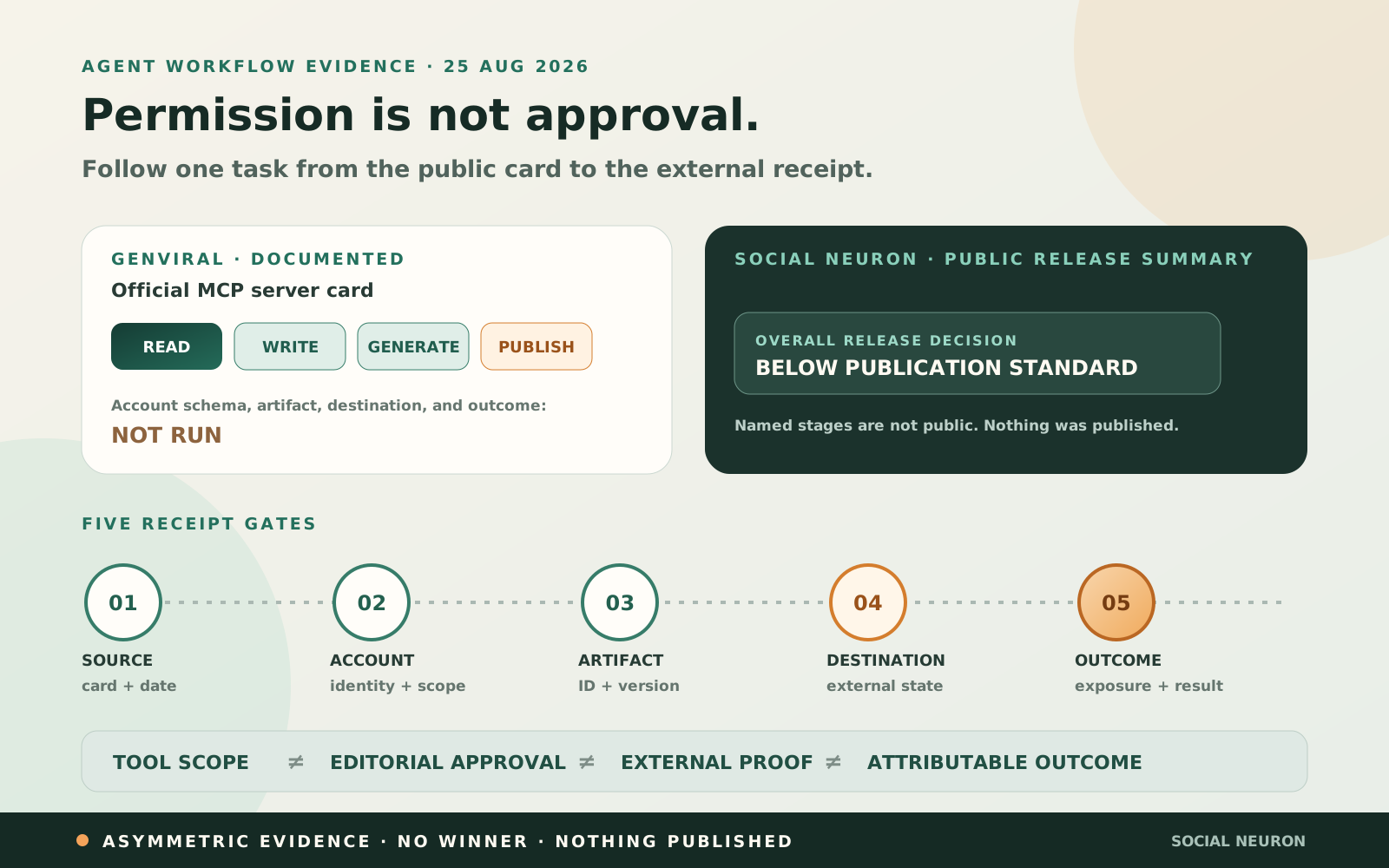
Permission is not approval
An OAuth permission answers whether a call may be attempted. It does not answer whether this artifact should be published now.
A safe agent workflow separates at least four controls:
- Connection authority: which account, project, and endpoint the agent can reach.
- Tool authority: which read, write, generate, or publish operations the account exposes.
- Editorial approval: which exact artifact version a person or policy has approved.
- External proof: which destination accepted the artifact and what state it reached.
This distinction prevents a common comparison error. A longer tool list does not imply stronger safety, better output, or broader task authority. A shorter list does not imply the opposite. The test must inspect the exact account surface and follow one task through receipts.
The MCP connector comparison applies this rule across several tools. The independent verifier guide explains why the same system should not grade its own external-state claim.
Where GenViral is the clearer documented fit
GenViral is the clearer fit from current documentation when:
- the buyer wants its documented MCP, REST, CLI, or agent-skill path;
- creation, scheduling, publishing, analytics, and automation should sit in one named product surface;
- slideshows, Studio generation, or hosted-account options are part of the job;
- account-scoped developer operations are a primary buying criterion; or
- the team can verify its plan, permissions, connected accounts, and destination receipts directly.
This is a documented-fit conclusion. It is not a claim that the operation is reliable in every account, that hosted accounts avoid enforcement, or that GenViral improves reach.
Where Social Neuron is the clearer documented fit
Social Neuron is the clearer fit from current documentation when:
- the workflow begins with a named project and persistent brand context;
- explicit review and approval should sit before distribution;
- the operator wants creation, delivery, analytics, and the next decision treated as one controlled workflow;
- failed artifacts must remain visible instead of being silently regenerated; or
- a hosted service is preferred over assembling the workflow from separate components.
The AI-agent operating loop explains that control model. The cross-platform proof protocol shows the identity-to-outcome chain required before a publish claim becomes evidence.
The private Social Neuron evaluation did not meet publication standard. Stage-level results are not public, and no comparative claim follows from the release decision.
Why the old winner story was removed
The previous article made MCP availability the central difference. It also claimed a Social Neuron tool total, universal client compatibility, broader model access, automatic improvement, a fixed platform matrix, predictable costs, stronger enterprise security, autonomous management, and compounding quality. It described GenViral as API-only, flat-authenticated, cheap, TikTok-only, static, and dependent on a custom MCP wrapper.
Current first-party evidence contradicts several of those statements. The remaining superiority claims had no matched account, common brief, blind review, artifact lineage, verified exposure, denominator, or attribution.
The correction removes the binary. Both vendors document agent paths, generation, distribution, and analytics. Neither has a verified comparative outcome in this review.
How to run a fair no-publish test
Use the product-neutral agent workflow receipt sheet. The test stops before any external write.
1. Freeze one task
Use one non-sensitive source brief, target platform, format, brand input set, review criteria, time budget, and one-generation rule. Do not regenerate the weaker result.
2. Record exact identity
Capture product, plan, endpoint, transport, account, workspace or project, connected-account state, and the source date. Stop if any identity is ambiguous.
3. Begin read-only
Retrieve the account-visible schema and permission state. Record a before-and-after zero-write check. A public server card is the expected surface, not proof of the account surface.
4. Produce one internal draft
With publishing permission withheld, create one artifact in each product. Preserve the source brief, durable ID, version, platform lineage, reviewer decision, and exact actions not taken.
5. Review blind and keep the loser
Use the same review criteria without vendor labels. Keep both results and every failure. One run can show workflow behavior. It cannot prove a universal product ranking.
6. Separate any delivery test
A later approval must name the exact artifact version, destination account, allowed action, rollback rule, and external receipt. The article test itself does not need publication.
7. Measure only after verified exposure
If an editorial experiment is approved, change one answer-block variable. Record apex and app-host behavior, article-attributed demand, and server-side signup and activation at 1 hour, 24 hours, 7 days, 14 days, and 28 days. Missing analytics remains unavailable, not zero.
Limitations and falsifier
This is an asymmetric documentation review. GenViral was not tested against an account. Social Neuron had one private evaluation, and only its release decision is public. Neither product was tested for destination reliability, audience response, signup, activation, payment, retention, or causal lift.
First-party pages can describe a capability more broadly than a plan or account exposes. Public server cards can also change between retrieval and publication. Security depends on the exact transport, scopes, account, connected providers, data path, configuration, and operating controls. This review does not rank either product's security.
Withdraw or update a matrix row when its cited source no longer supports the claim, an account does not expose the documented operation, or a controlled run contradicts the state. Withdraw any outcome statement without an exact external artifact, verified exposure, denominator, attribution method, and registered measurement window.
Frequently asked questions
Does GenViral have an MCP server?
Yes. GenViral publishes an MCP endpoint, an agent page, and a machine-readable server card. The current card describes OAuth permission groups for read, write, publish, and generate operations. This review did not connect that endpoint to an account.
Which permissions can a GenViral agent request?
The current official agent and server-card surfaces separate read, write, publish, and generate authority. Buyers should inspect the exact scopes granted to their account and withhold publish authority during the first controlled test.
Can either product generate and publish autonomously?
Both document creation and distribution operations. Tool access is not standing editorial authority. Require an exact artifact version, approval record, connected-account identity, destination receipt, and verified external state for every publish claim.
Does either product prove that analytics improve the next post?
Not in this review. Analytics availability is not a closed learning trace. The proof must connect a prior decision, action, measured outcome, policy update, and later policy read, then test whether that change improves an attributable result.
How should a buyer compare two agent-oriented social tools safely?
Freeze one task, record exact identity and permissions, begin read-only, produce one internal draft per product, preserve both results, and stop before publishing. Run any destination or outcome test under separate approval.
Sources
Retrieved 24 August 2026 and reachability checked 25 August 2026:
- GenViral, homepage and pricing.
- GenViral, agent and MCP surface.
- GenViral, Partner API documentation.
- GenViral, MCP server card.
- Social Neuron, developer surface and Brand Brain.
Next step: Download the receipt sheet, lock one task and account configuration, and leave every untested execution or outcome cell open.