Blender MCP for Architecture: A 20 cm Roof Test
Published · Updated · 15 min readArchitecture teams can make persuasive visuals long before they can prove the scene still matches the brief. We tested the smaller, more useful question: can an MCP-connected assistant change one declared dimension in Blender and leave the rest of a synthetic design alone?
Can Blender MCP help with architectural visualization?
Yes, when it is used as a controlled bridge to an editable Blender scene. An MCP-capable assistant can inspect scene data, run reviewed operations, render defined views, and help record revisions. The connection does not make a design safe, buildable, accurate, or compliant. Those conclusions still belong to the authoritative project model and qualified reviewers.
The useful output is not simply an attractive image. It is an editable scene, a declared source, a review record, and exported visuals tied to approved information.
Evidence status, checked 21 September 2026
Documentation evidence: Primary sources include OpenAI's Astra example, the pinned Blender MCP documentation, World Labs' Atlas documentation, and Blender 5.2 output guidance.
Fresh synthetic run: MCP for Blender 2.0.3 connected to Blender 5.2.2 LTS. We seeded a 6.0 by 4.0 metre roof, corrected it to 6.2 by 4.2 metres, restored the 0.1 metre overhang, and matched a signature across 64 non-roof design objects.
Product handoff: No Social Neuron upload, draft, distribution, or outcome test was completed. This is not a customer case study and does not establish construction accuracy, repeat reliability, client acceptance, reach, enquiries, or revenue.
Keep four jobs separate
AI architecture demonstrations often blur source design, visualization, spatial generation, and marketing into one prompt. They are different jobs with different evidence.
| Layer | Useful role | What it does not establish |
|---|---|---|
| BIM, CAD, survey, or approved drawings | Authoritative dimensions, revisions, specification, and project facts | Permission to let a model invent missing design decisions |
| Blender with reviewed scripts or MCP operations | Editable visualization geometry, controlled cameras, materials, and repeatable renders | Structural safety, planning approval, accessibility, or professional sign-off |
| World or visual model | Rapid spatial exploration, concept communication, and alternative views | Hidden dimensions, faithful unseen geometry, or a construction model |
| Editorial workflow | Approved copy, disclosures, media variants, review, and distribution records | Design approval or proof that the content caused a business outcome |
The strongest workflow can use all four layers, but it must preserve the boundary between them. An architect can approve a source revision. A visualization artist can build a downstream scene. A spatial model can help explore presentation. An editorial team can explain the reviewed result. Popularity at the last stage is not permission to alter the first.
What did OpenAI demonstrate with Astra?
OpenAI's architectural visualization article describes a house developed through concept reviews, detailed rooms, camera studies, and an Unreal Engine walkthrough. Astra used Blender's Python API, bpy, scripts run through Blender's executable, computer use, and saved-render review. The article does not identify Blender MCP as its connection.
The reusable lesson is the review sequence: approve direction before expanding the scene, preserve earlier versions, inspect rendered outputs, and treat transfer to an interactive engine as a separate gate. OpenAI also frames the result as visualization that requires professional review before informing construction. A convincing render is not a structural calculation with better lighting.
How does the Blender MCP connection work?
The project now presents itself as MCP for Blender and notes that it was formerly named blender-mcp. We use the phrase Blender MCP because it describes the connection readers search for, while links point to the renamed project.
The project README reviewed on 21 September 2026 describes the integration as third-party software with two parts: an add-on inside Blender and a separate Python MCP server. The server source reviewed on the same date connects the MCP process to the add-on through local TCP. The MCP client launches and communicates with the server over standard input and output.
- The assistant talks to the MCP server through standard input and output.
- The server opens a local TCP connection to the Blender add-on.
- The add-on receives allowed operations for the open scene.
A local Blender socket is not the same thing as a hosted HTTP MCP endpoint.
If those transport terms are unfamiliar, read our plain-English MCP guide before connecting a tool that can change scene data.
Installation details can change. Record the exact revision and package version, and begin with a disposable scene.
What should an architecture practice protect first?
Treat the bridge as software with write access. The reviewed source exposes an execute_blender_code operation that can run Python. Its safe-mode validation is not a proven sandbox.
The terms reviewed on 21 September 2026 say opted-in content collection can include prompts, generated code, scene metadata, and viewport screenshots. The README says content collection is off by default, while minimal anonymous usage events remain on unless DISABLE_TELEMETRY=true is set. Recheck current terms before confidential use.
Before connecting a real project:
- Review bridge terms, provider policies, and the client agreement.
- Obtain permission for the data and processing route.
- Start with a separate synthetic scene that contains no client information.
- Keep the authoritative project outside the writable experiment.
- Disable optional collection and external services, then verify the setting.
- Inspect proposed code, save before mutation, and stop the listener afterward.
If those conditions cannot be met, use approved stills instead of connecting the design model.
What happened in the 20 cm roof test?
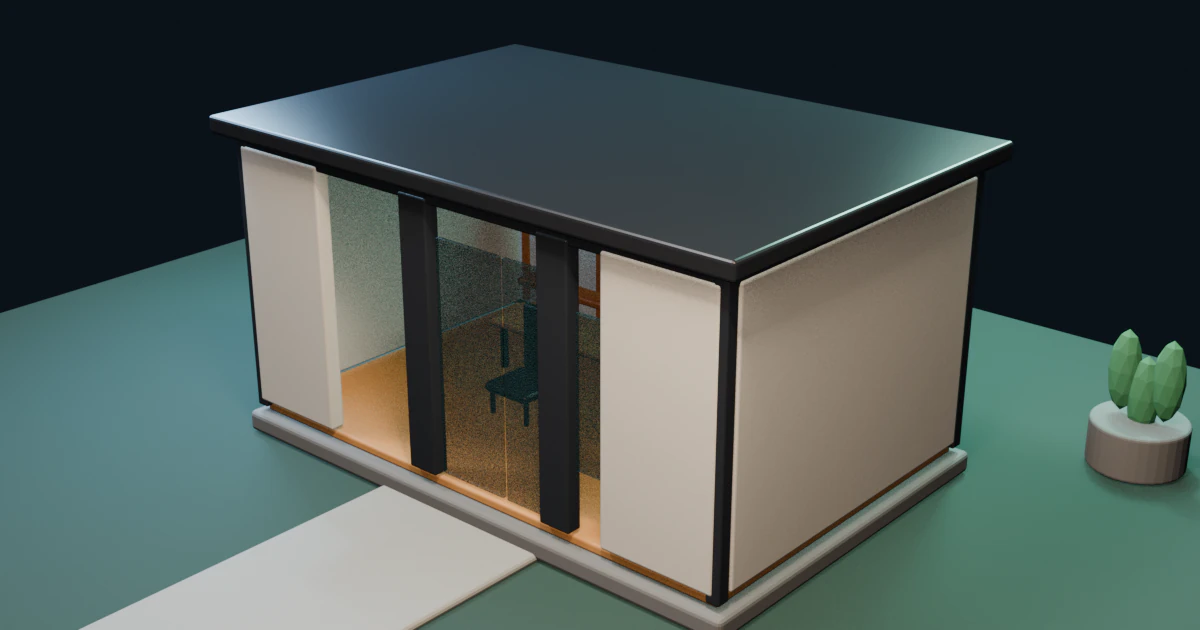
We designed the run to make a wrong result visible. The synthetic brief fixed the wall footprint at 6.0 by 4.0 metres and required a roof overhang of 0.1 metre on every side. The correct roof footprint was therefore 6.2 by 4.2 metres. We deliberately started with a roof that matched the walls instead.
The test used Blender 5.2.2 LTS, MCP for Blender 2.0.3, add-on version 1.7, and MCP protocol 2025-11-25. We started Blender with factory settings, enabled the bridge's safe-mode validation, disabled its telemetry, and kept external asset integrations off. These controls describe this isolated run. They do not turn Blender or the local add-on socket into a security sandbox.
The first setup attempt failed before scene generation. Blender 5.2.2 rejected an older render-engine enum used by the harness, so the run stopped and produced no proof artifacts. We updated the disposable harness to the current enum and started again. Keeping the failed attempt separate matters: a green final render should not erase the path that failed.
R00: the deliberate error
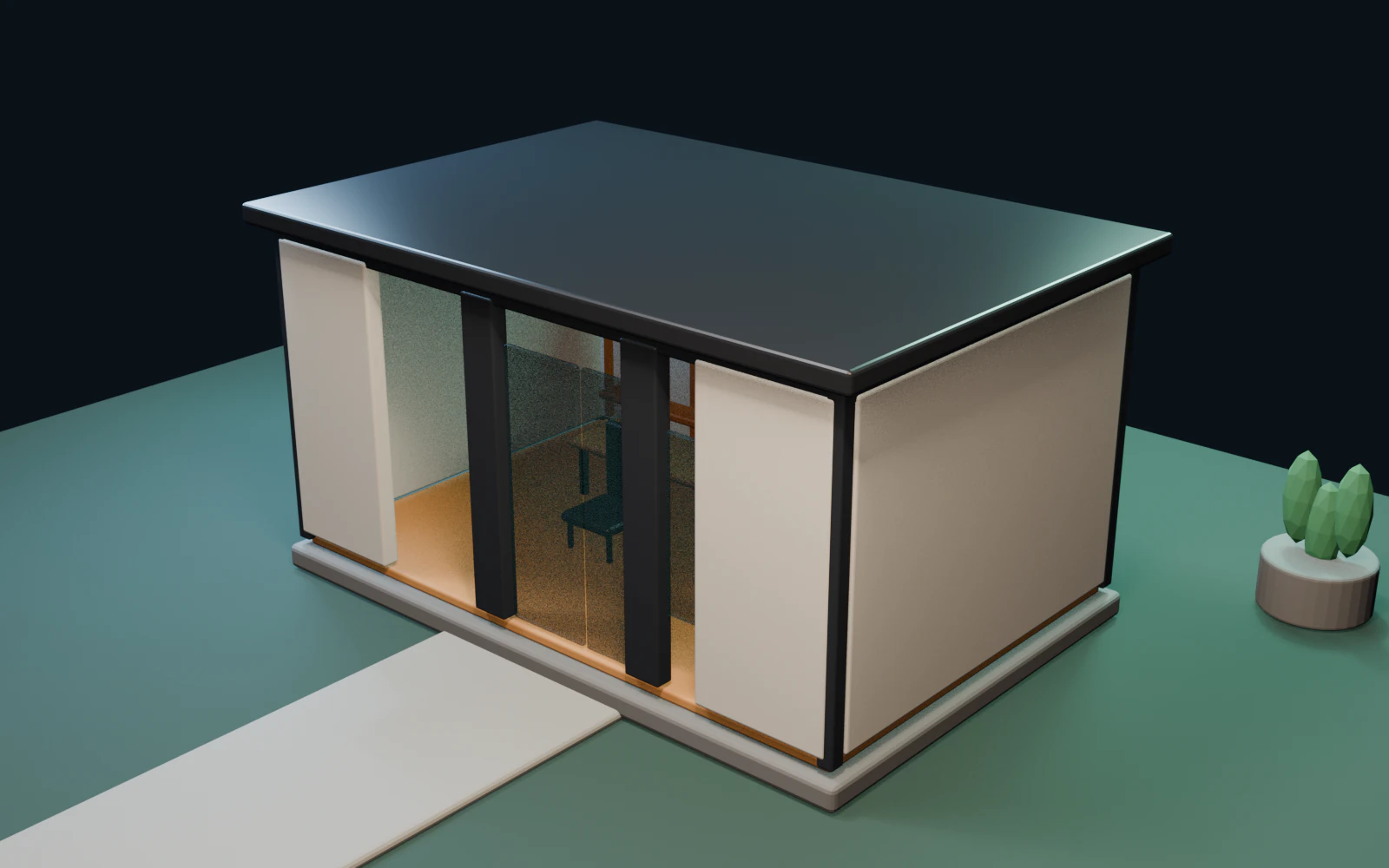
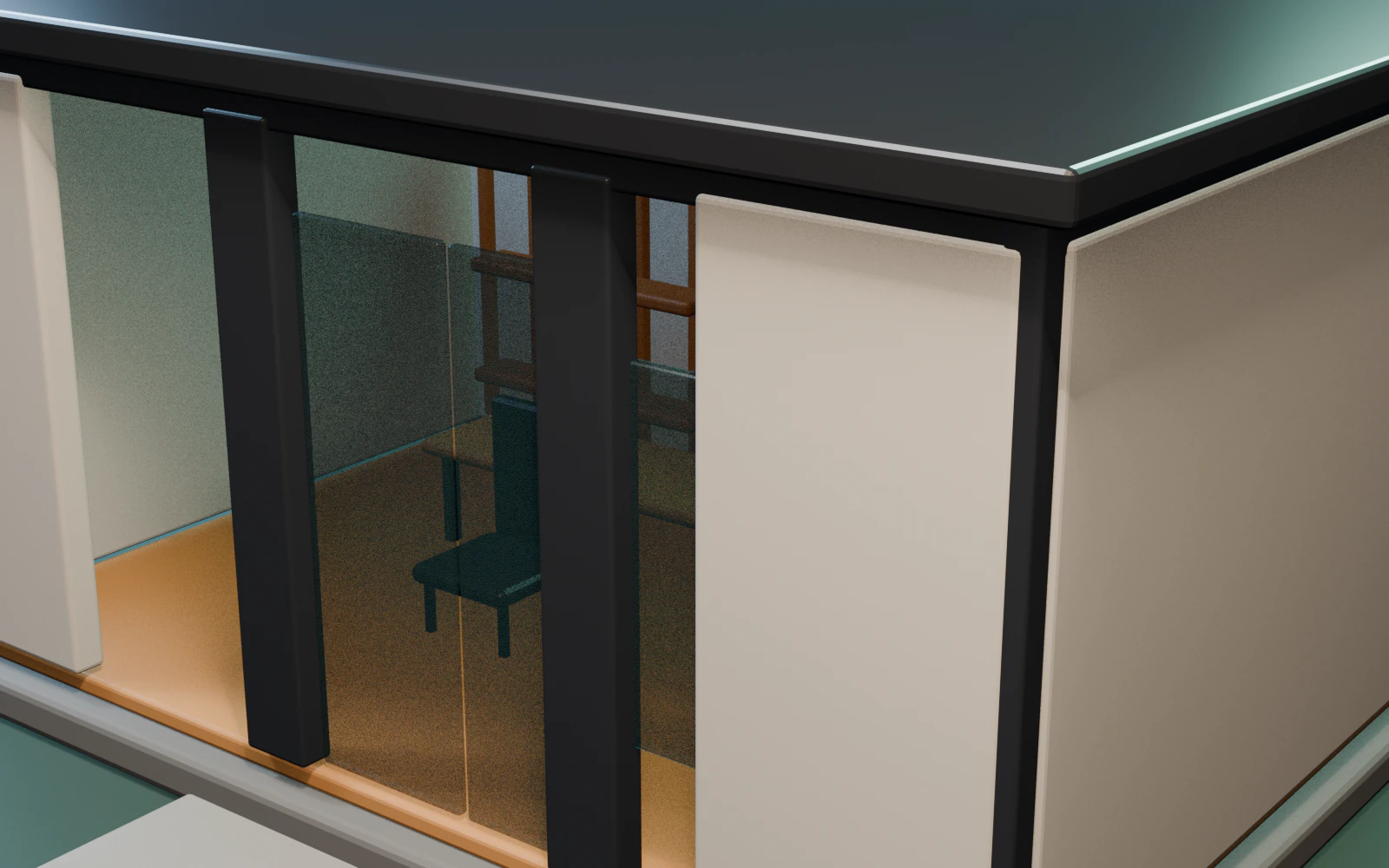
The MCP connection created the garden-studio scene in eight named collections. The R00 geometry receipt reported a 6.0 by 4.0 metre wall footprint and a 6.0 by 4.0 metre roof. That meant zero overhang. The original Blender renders use the baked labels CHECK 01 and REVISION 01; the public receipt maps those exported states to R00 and R01. We left the proof renders unaltered. The pass or fail decision came from the queried object dimensions, not from looking at pixels.
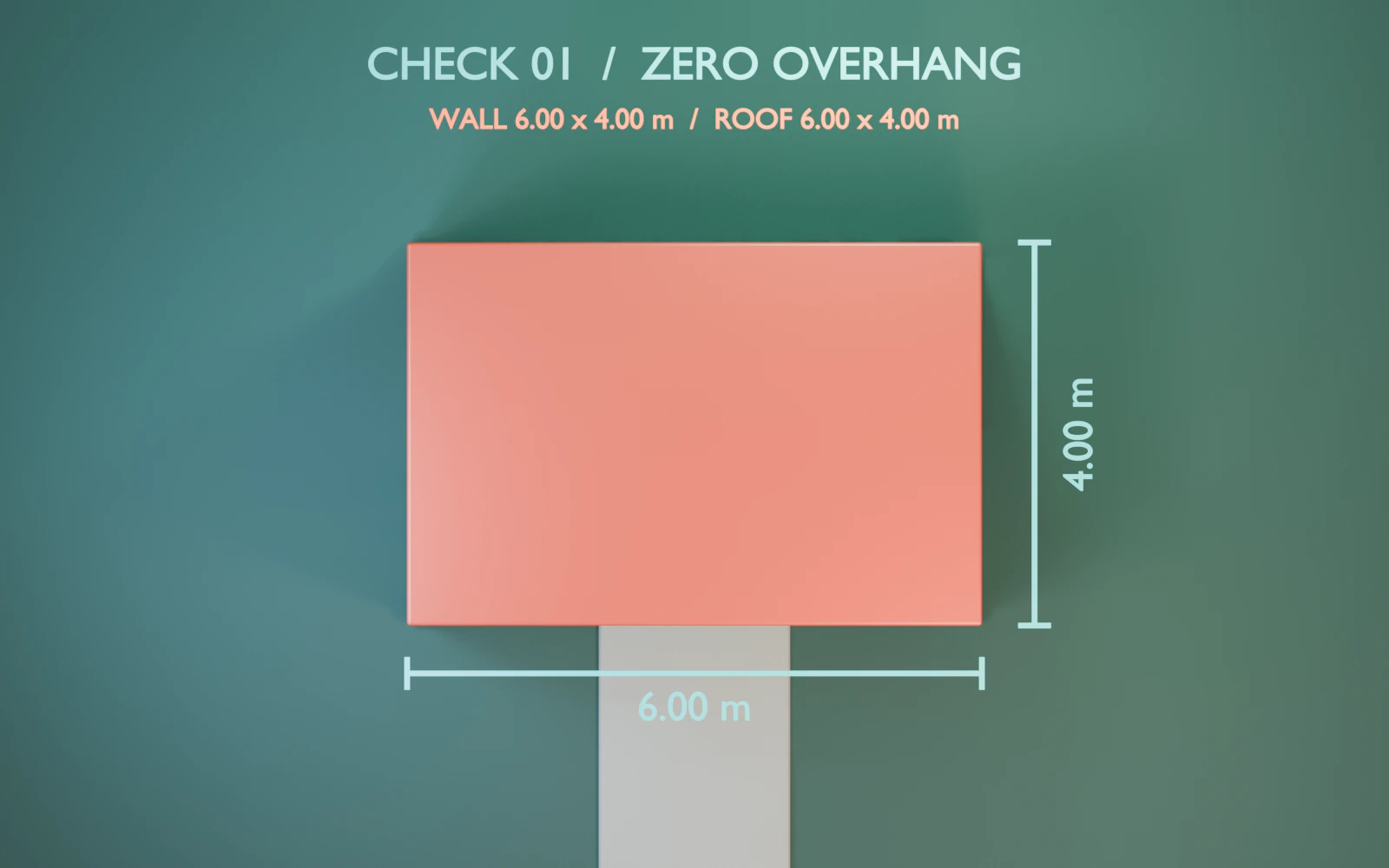
The roof was 0.2 metre short on each overall axis. Because the difference is shared across two sides, the missing overhang was 0.1 metre per side. This was a deliberately seeded acceptance error, not an accidental defect that the system discovered unaided.
R01: one bounded correction
The correction changed the named roof object to 6.2 by 4.2 metres, then queried the scene again. The R01 receipt reported the required 0.1 metre overhang on each side.
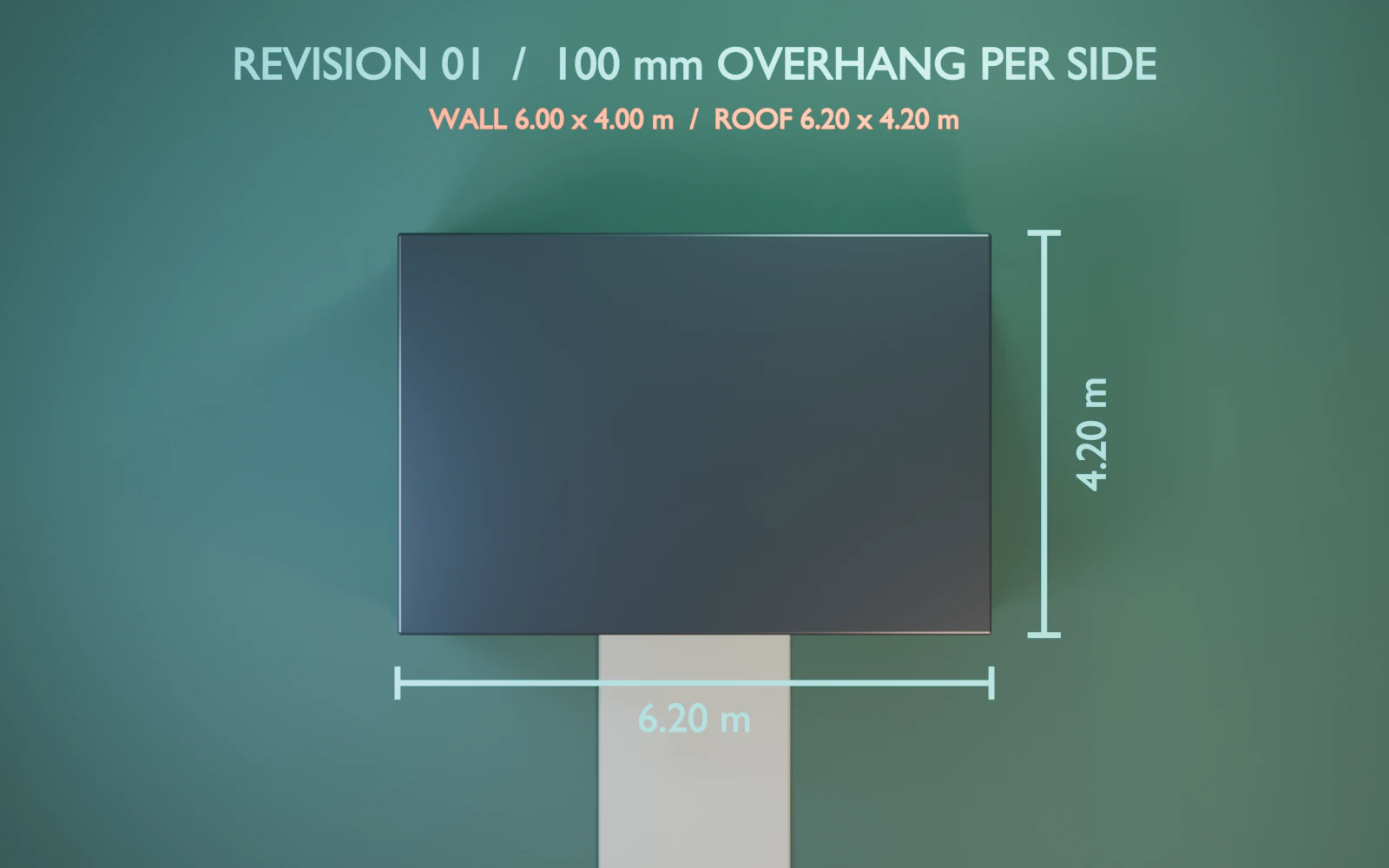
We also computed a signature over 64 non-roof design objects using each object's name, type, collections, location, dimensions, and materials. The R00 and R01 signatures matched exactly. R01 contained two additional cameras for the exploded and detail renders; they were classified as render-only additions rather than design changes.
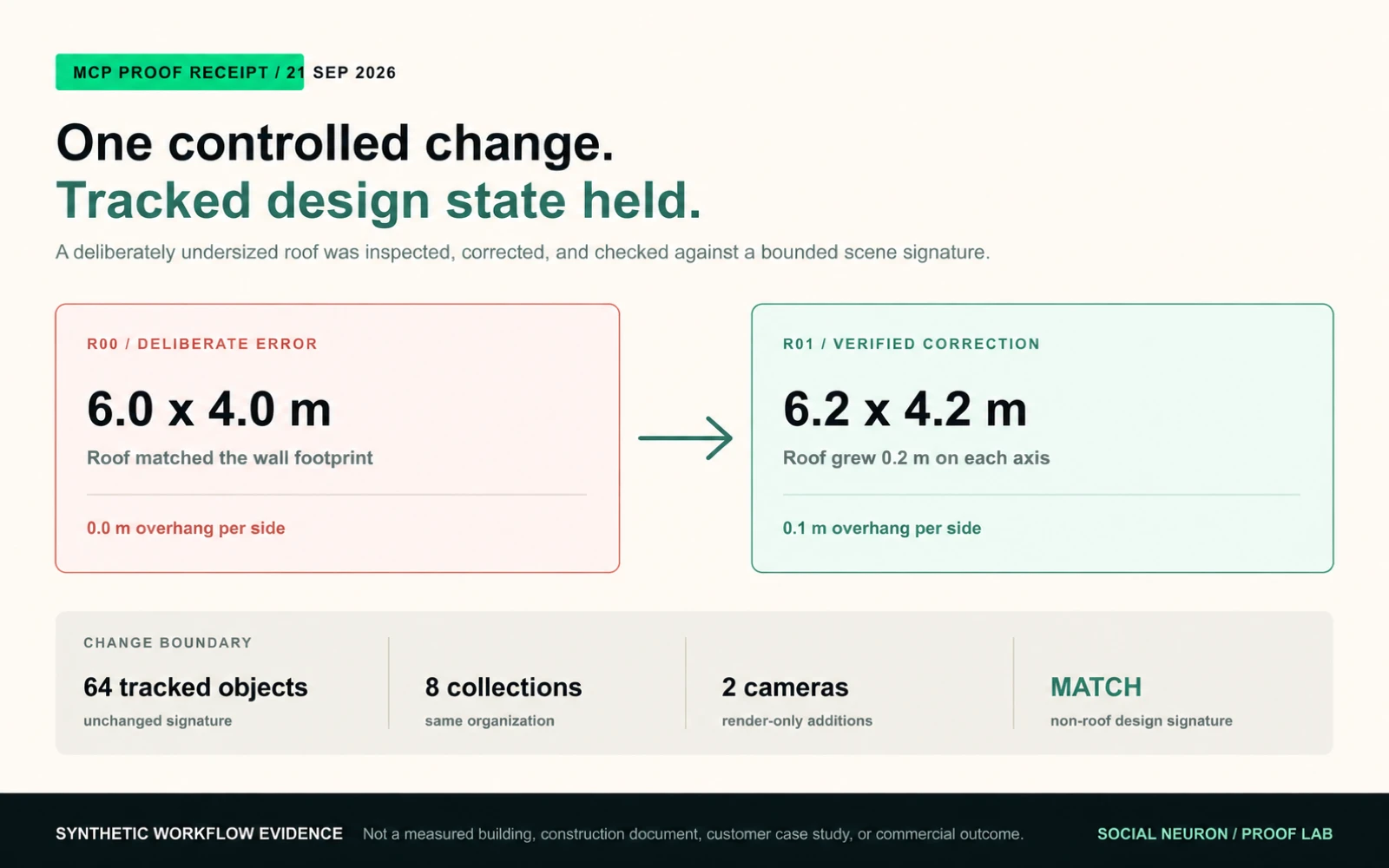
The public package includes a machine-readable evidence manifest and a product-neutral acceptance CSV. They contain software versions, measurements, artifact hashes, controls, and limits. They exclude raw Blender files, source frames, scripts, prompts, logs, local paths, account data, project identifiers, and authentication details.
The animation is communication, not dimensional proof
Blender 5.2's manual recommends rendering an image sequence before encoding video. We rendered 48 PNG frames through the MCP-connected scene, inspected them, then encoded a two-second H.264 file without identifying or custom metadata; generic codec and container tags remain. The paired geometry receipts remain the dimensional evidence.
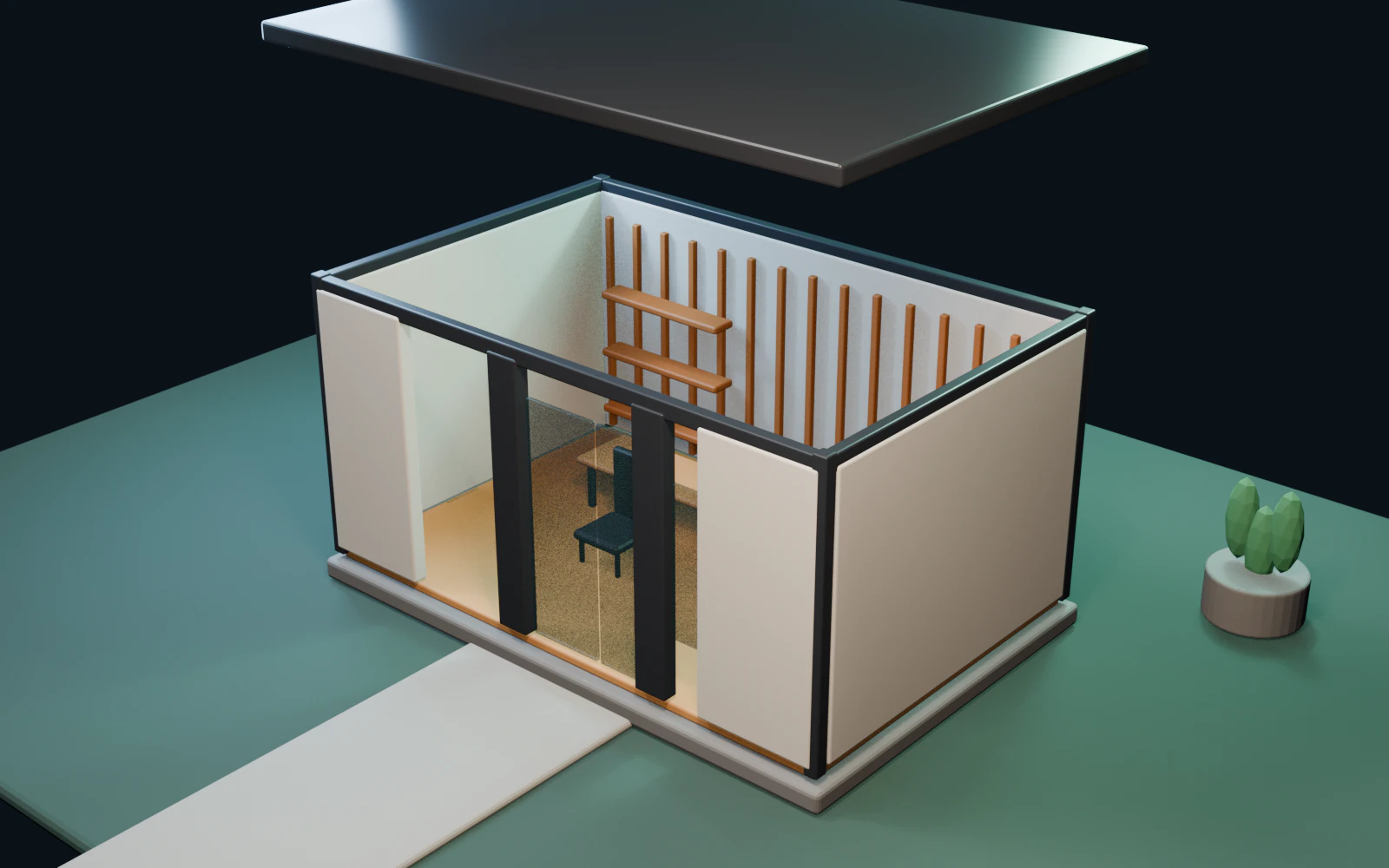
The run passes its narrow acceptance test: it reported the wrong value, corrected the named geometry, preserved the bounded non-roof signature, and tied the public visuals to the corrected revision. It does not prove repeat reliability, import fidelity, confidential-project safety, or a customer outcome.
Where do world models and visual models fit?
World models are useful when the question is spatial exploration rather than construction documentation. World Labs describes Atlas as generating controlled views and spatial outputs from references. Its architecture examples and Spatial Real Estate showcase demonstrate the communication opportunity. These vendor examples do not guarantee dimensions, unseen geometry, material fidelity, planning compliance, or conversion results.
The ElevenLabs room-build reel shared with us is a useful format reference: the scene visibly assembles as floor, walls, furniture, and lighting appear. Its public post does not expose the production method or prove geometric accuracy. The idea to borrow is the legible state change, not an unsupported claim about the tool behind it.
A responsible version starts with a declared source, assembles named layers, pauses on an inspection checkpoint, and ends on a reviewed revision. The animation communicates. The geometry query and receipt provide evidence.
Where do Revit, SketchUp, Rhino, and Unreal Engine fit?
Do not rebuild an established practice's design process to put Blender in a blog title. If Revit, Archicad, SketchUp, or Rhino holds the reviewed design, keep it authoritative and treat Blender as a downstream representation.
Epic's Datasmith compatibility documentation describes direct, export, and plugin routes for supported design software. Versions and operating systems matter. That documentation does not imply that every application has an MCP server or a native Social Neuron integration.
Unreal Engine becomes relevant when a review requires interactive movement. OpenAI's example shows why transfer needs a separate gate for coordinates, units, materials, lighting, and collision. For many practices, approved stills and a short sequence are enough.
How does the scene become social content?
Editorial needs a reviewed export plus a claim ledger: source revision, approved statements, required disclosures, and unknowns.
A concept render needs a concept label. An existing property should not gain an invented view, opening, or amenity to attract attention.
Keep design review and editorial review separate:
- The design owner approves the source facts and visual revision.
- The editorial owner selects one audience question per asset.
- Copy names the source status and avoids unverified design claims.
- A reviewer checks the export, caption, link, and disclosure together.
- Distribution remains approval-gated and returns a destination receipt.
After the design team approves the export, the next test is to give Social Neuron only the permitted media, correction log, concept disclosure, and approved claims. Use it to check and adapt the editorial copy, keep human approval before scheduling to a supported connected destination, and retain delivery and analytics evidence separately. We did not run that end-to-end Social Neuron handoff for this article, so this is a proposed workflow, not a product result or business outcome. Our MCP content-pipeline guide explains the orchestration layer, while the real-estate listing-video guide covers the different task of animating approved property photographs.
What would count as a business outcome?
This synthetic run proves a mechanism, not demand or revenue. After publication, measure the article and any separately approved post as one attributable test. Unavailable analytics are not zero activity.
| Review point | Inspect | Do not infer |
|---|---|---|
| 1 hour | Page, canonical, asset, and destination delivery receipts | Audience response or search performance |
| 24 hours | Captured visits, artifact use, post state, and qualified replies | Causation from impressions alone |
| 7 days | Search impressions and clicks, identifiable referrals, and architecture-specific enquiries | Stable ranking or revenue effect from a small sample |
| 14 days | Repeated questions, practitioner objections, signups, and attributable server-side activation | That missing client analytics means zero interest |
| 28 days | Query ownership, assisted-conversion evidence, rejected hypotheses, and the next single-variable test | A customer case study without a customer and comparable baseline |
The first useful commercial signal is a qualified practitioner asking to inspect or reproduce the workflow with a non-confidential scene.
Limitations and falsifier
This guide needs material revision if the current Blender MCP architecture, execution permissions, or data terms differ from the documentation reviewed on 21 September 2026. The evidence should be withdrawn if the published hashes do not match the files, the receipt cannot reproduce the stated measurements, or a review finds that the bounded signature omitted a design object it claimed to cover.
Even a successful run would not prove confidential-project safety, repeat reliability, geometric fidelity across imports, construction readiness, or a marketing outcome. Those require separate tests with explicit permission and appropriately qualified reviewers.
Frequently asked questions
Is Blender MCP required to use Astra with Blender?
No. OpenAI's published example uses Python scripts and computer control. Blender MCP is a separate connection option. Test the exact route you intend to use.
Can this produce construction-ready architectural plans?
The sources reviewed here do not establish that. Visualization and scene inspection do not replace site-specific design, structural analysis, accessibility review, or regulatory approval.
Can it start from an existing Revit or SketchUp project?
Potentially, through an appropriate reviewed export and visualization workflow. Verify application versions, units, axes, materials, object identity, and geometry after transfer. Do not assume BIM information survives a mesh export.
Does running Blender locally keep client information private?
Not necessarily. The model provider, MCP bridge, optional asset services, and telemetry can each introduce data processing. Review every route before connecting confidential work.
What does this test prove?
It proves one synthetic mechanism on one dated setup: the MCP connection reported a deliberately wrong roof dimension, applied the bounded correction, and preserved the tracked non-roof design signature. It does not prove that every operation, import, confidential project, or marketing handoff will behave the same way.